What Is Reiki?
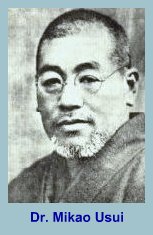
Reiki is one of a number of healing systems commonly thought of as "energy healing", all of which use and direct the life force energy--or "chi"--in one way or another to facilitate healing. Dr. Mikao Usui founded the Usui system of Reiki in Japan in 1922. There are many myths and legends surrounding Dr. Usui and the origins of Reiki, most of which cannot be verified. The best information to date indicates that Dr. Usui discovered Reiki during a mystical experience on Mt. Kuriyama, a sacred mountain in Japan, during an intensive retreat involving study, fasting, and meditation. It was during this retreat that Dr. Usui received the great gift of the Reiki energy through his crown chakra, and realized that he had received a wonderful gift--the ability to heal others. Later, he developed the various levels of
training, added the Reiki symbols, and developed a series of spiritual attunements through which he was able to pass this ability on to others.
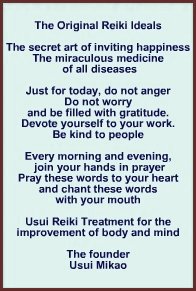
Dr. Usui operated a Reiki clinic and taught his system of healing throughout Japan until his death in 1926. He initiated Dr. Chujiro Hayashi as a Reiki Master in 1925, and Dr. Hayashi made a number of changes to the method of performing Reiki, including detailed hand positions for particular illnesses or conditions, and having the reciprient lie down during treatment.
In 1938, Dr. Hayashi initiated Mrs. Hawayo Takata as a Reiki Master, and she practiced and taught the method in Hawaii until her death in 1980. Mrs. Takata chose to modify the system even further by creating her own hand position method. Mrs. Takata initiated 22 Reiki Masters, and those 22 taught others, and so on down the line, until today it is estimated that there may be as many as one million Reiki Masters in the world today, and as many as 4 million people who have been initiated into Level I or Level II Reiki.
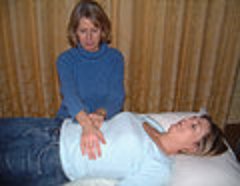
During a Reiki session, the client will typically be lying on a bed or massage table, fully clothed. After invoking the Reiki symbols, the Reiki practitioner transfers the Reiki energy to the client by placing his or her hands on or near the client's body in various locations. The Reiki heaing energy enters the practitioner's body through the crown chakra and flows out through the eyes, mouth, and hands. The practitioner allows his own consciousness to "stand aside" and allow the Reiki energy to flow through
unimpeded by his or her own thoughts, goals, or desires. The individual who is receiving the Reiki energies often feels a sense of deep relaxation, and may also feel a sensation of warmth emanating from the practitioner's hands. However, the practitioner can also transmit the energy to anyone, anywhere, by way of the distance healing process, since energy is not bound by time, space, or distance...similar to the way in which we believe our prayers are transmitted across space and time. The method by which distance healing is performed varies with the individual practitioner, but it typically involves either performing the Reiki on a proxy or simply visualizing the recipient and directing the Reiki energy to the visual image.
Although at times a healing or the relief of symptoms may occur very quickly, it is more often the case that the healing unfolds gradually as the spiritual body heals and begins to reflect this healing in the physical body. Chronic or deep-seated conditions often require a series of healing sessions, although immediate relief is certainly possible also.
It is also possible that Reiki healing may not result in the alleviation of specific symptoms, as in the case of chronic or terminal illness. However, Reiki can promote a condition of peace, wholeness, wellness, empowerment, and spiritual strength, even in such cases as these.
Although Reiki is a spiritual practice, it is not a religion; it is not connected with any religion, nor is it at odds with any religion. Dr. Usui himself wrote in his Reiki Ryoho Handbook that "Our Reiki Ryoho [Healing System] is something absolutely original and cannot be compared with any other spiritual path in the world." Dr. Usui may or may not have been a Buddhist...we are not sure...but we do know that he studied Christianity and lived with a Christian family for a time. He studied medicine, psychology, and religion in school. Japanese Reiki master Toshitaka Mochizuki, who has researched the history of Reiki, believes that Dr. Usui was most probably a spiritualist and psychic as well. After his initial mystical experience of receiving the Reiki energies, he drew upon his broad and varied religious, philosophical, and medical background to develop his healing system.
If you are interested in learning more about the history of Reiki and how it is practiced, I would recommend these two excellent sites, from which much of the above information was obtained:
The International Center for Reiki Training and Reiki.nu


Reiki healing complements traditional medicine. Everyone is able to benefit from it. However, I am not a doctor, nor a health care professional of any kind. Reiki healing should not be construed as the practice of medicine. Although my sincere hope and prayer is that you will receive the healing that you desire, no specific outcomes can be predicted or guaranteed. If you have physical or psychological problems, you should seek medical attention. If you are already under the care of a physician, you should continue to follow your treatment plan as prescribed.
